How Much Does a Sushi Making Class in NYC Cost? (2026 Prices)
The honest sushi making class NYC cost sits between $63 and $120 per person, checked on 5 September 2026, and where you land depends on whether you want two hours of rolling or three hours that reach nigiri. Below is every real price, what each ticket actually buys, the costs nobody mentions until checkout, and the math that tells you whether a class beats a nice dinner out. To compare the classes themselves, start with the sushi making class NYC guide.
Quick answer
A sushi making class in NYC costs $63 for a two-hour class and $120 for the three-hour Midtown workshop, checked 5 September 2026. Two of the three classes running in Manhattan sit at $63, so that is what most people pay. Every ticket covers ingredients, equipment and the meal you make; drinks and tips are on top, and none of the three is refundable.
Key takeaways
- Prices run $63 to $120 per person — there is no tier above that in Manhattan
- The $63 two-hour classes include everything you eat; drinks are sold at the venue
- The $120 Midtown workshop folds in soft drinks and adds nigiri and sashimi
- Booking direct with the operator can be $59 for the roll class and $65 for the Nikkei one — cheaper one way, dearer the other
- The real hidden cost is the cancellation policy: all three are final sales, so a missed date is the whole ticket
Price Overview 2026
Every class actually running in the city right now, and what it costs. Prices checked on the booking platform on 5 September 2026, per person.
| Class | Duration | Price per person | What's included |
|---|---|---|---|
| Hand-Rolled Sushi, Midtown West | 2 hours | $63 | Ingredients, tools, three rolls, your own ponzu, the meal |
| Nikkei Peruvian Sushi, Midtown South | 2 hours | $63 | Ingredients, tools, two maki, salmon tartare, two sauces, the meal |
| Sushi Workshop for Home Chefs, Midtown | 3 hours | $120 | Ingredients, tools, nigiri, sashimi and rolls, dinner plus soft drinks |
Prices move with demand, particularly on Friday and Saturday evenings, so treat the table as a snapshot and read the live number on the booking page before you commit. What does not move is the shape of it: two hours costs about half what three hours costs, and the extra hour is where nigiri lives.
Sample Budgets
What an evening really costs once drinks and an optional tip are counted. The class prices are the platform's, the extras are typical Midtown prices, and nobody is obliged to tip at a cooking class.
| Booking | Class tickets | Drinks + tip | Realistic total |
|---|---|---|---|
| One person, two-hour class | $63 | About $20 | Around $85 |
| Couple, two-hour class | $126 | About $40 | Around $165 |
| Couple, three-hour workshop | $240 | Tip only | Around $260 |
| Four friends, two-hour class | $252 | About $80 | Around $330 |
Two notes the table cannot carry. The workshop already includes soft drinks, so there is no bar tab against it — that is part of why the gap narrows once you compare evenings rather than tickets. And parties of six or more get a 14-day reschedule deadline with the operator instead of 48 hours, so large group bookings need locking in earlier than you would think.
What's Actually Included
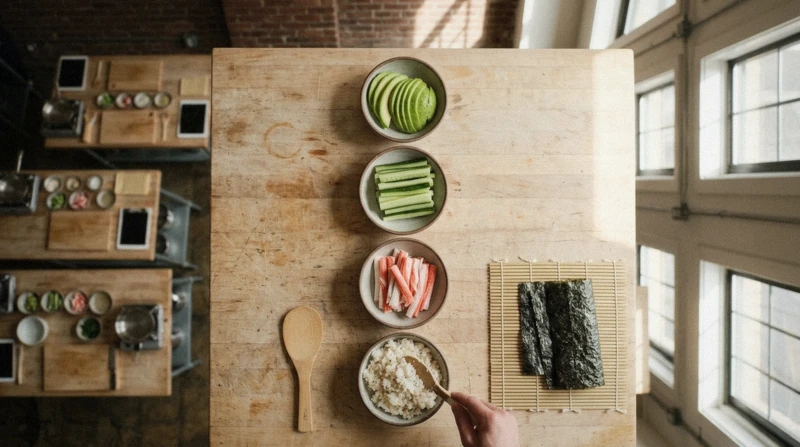
All three classes include the same baseline: every ingredient, a mat and knife at a station prepared before you arrive, the chef, and the meal you make. Nothing is upsold in the room, and the price on the booking page is the price, aside from drinks and whatever you decide to tip.
The difference is what comes out of your hands. Two hours buys you rolls — three at the Midtown West class, two plus a tartare at the Nikkei one. Three hours buys the rolls plus nigiri and sashimi, which need hand-pressed rice and fish sliced to order rather than a mat, and that is why the workshop needs the extra hour rather than simply moving faster.
- The roll class makes a spicy tuna roll, a traditional veggie maki, a salmon avocado roll and your own ponzu sauce
- The Nikkei class makes tuna and sweet potato maki, a salmon yuke tartare and two Peruvian pepper sauces
- The Midtown workshop adds nigiri and sashimi, and includes soft drinks and all fees with the dinner
- The fish varies by session at every class, because it depends on what came in that day
- Dietary substitutions — vegetarian, vegan, gluten-free, nut-free, dairy-free, kosher-friendly, shellfish-free — are free, but only if flagged when you book
What Moves the Price
Three things account for the whole $57 spread. Our write-ups of the Midtown workshop and the two-hour roll class show each of them inside a single session.
- Class length: the workshop runs a full hour longer, and that hour is most of the difference
- Technique depth: nigiri needs the chef at your shoulder individually; rolling can be corrected across a room
- Venue: the two-hour classes run in hotel rooms set up for the evening, the workshop in a dedicated kitchen on 5th Avenue
- Group size: 20 seats at the workshop against up to 26 at the two-hour classes, so chef attention per head differs
- Included drinks: soft drinks sit inside the $120 ticket and outside the $63 ones, so part of the gap is prepaid beverage
Costs That Aren't in the Ticket
The listed price is close to the real total, but four things sit outside it — and the fourth is the expensive one.
- Tips: optional at a New York cooking class, not automatic. Guests who want to thank the chef commonly leave $10–20; the operator states gratuities are excluded
- Drinks: sold at both two-hour venues and not permitted from outside, usually $8–16 each. The workshop includes soft drinks
- Getting there: all three venues are within a few blocks of Penn Station or Herald Square, so it is one subway fare each way
- A missed date: every class here is a final sale. Miss the evening and the ticket is gone — $63 or $120 depending on which you booked
The same list as a table, with the dollar range for each extra and when it applies. The first three are small; the fourth is the one that can cost you the whole ticket.
| Extra cost | Typical amount | When it applies |
|---|---|---|
| Tip for the chef | $10–20 | Optional, at every class |
| Drinks | $8–16 each | Two-hour classes; workshop includes soft drinks |
| Subway fare | About $3 each way | Every venue is a short walk from a major station |
| A missed booking | $63–$120 | All three classes — no refunds, no date changes |
What to Book at Each Budget
If You want the lowest real total
A $63 two-hour class with the drinks skipped. It is the cheapest way in this city to eat a sushi dinner you made and keep the method afterwards.
If You have about $85 per person
A $63 class, one drink and a small tip. That is the whole evening, dinner included, for less than most sit-down sushi for one.
If You have $120 per person
The three-hour workshop. Soft drinks and dinner are inside the ticket, so $120 is close to the full evening rather than a starting number — and it is the only class that teaches nigiri.
If You are booking for four
A two-hour class at $252 for the group. The same four seats at the workshop cost $480, and the extra $228 buys technique, not more food.
If Your plans might change
Book later rather than cheaper. No class here refunds, and the operator's own reschedule window is 48 hours for parties under six.
Is It Worth It? The Math Against Dinner Out
The comparison people actually make is a class against a nice sushi dinner. Here it is with the numbers lined up — omakase prices are the standard mid-range Manhattan band rather than a specific restaurant, and every class figure includes the meal you make.
| Option | Per person | Hours | What you keep |
|---|---|---|---|
| Two-hour class | $63 | 2 | Three rolls, a sauce and the method |
| Three-hour workshop | $120 | 3 | Rolls plus nigiri and sashimi technique |
| Mid-range omakase | $95–$150 | About 1.5 | The dinner |
Against omakase, a class costs the same or less for the food alone and the technique goes home with you. There is a second calculation worth running, though, and most guides skip it: the platform is not always the cheapest counter. The roll class sells direct for $59 against an $84 list price, below the platform. The Nikkei class goes the other way, $65 direct against $63 on the platform. Neither gap is large, but on a booking for four it is real money in one direction or the other.
What the class does not buy is flexibility. An omakase reservation can usually be moved; none of these tickets can. That is the honest trade at this price.
The short version: budget $63 to $120 per person, add a drink and an optional tip, and check the operator's own page before paying — it is sometimes cheaper, sometimes not. Whichever you pick, the ticket covers a full meal and a repeatable skill. Compare the classes side by side in our Brooklyn vs Manhattan breakdown, or see our gift guide if you are buying it for someone else.
Frequently Asked Questions
How much does a sushi making class in NYC cost per person?
Between $63 and $120, checked on 5 September 2026. The two two-hour classes in Midtown are $63 each, and the three-hour workshop that covers nigiri and sashimi is $120.
How much do you tip at a sushi making class?
Tipping is optional rather than automatic. Guests who want to thank the chef commonly leave $10–20. The operators state that gratuities are not included in the ticket, so nothing is added for you.
What is included in the price?
All ingredients, a mat and knife at your station, the instruction, and the meal you make. The $120 workshop also includes soft drinks and all fees. The $63 classes do not include drinks, which are sold at the venue.
Why is the workshop nearly twice the price?
An extra hour, plus nigiri and sashimi, which need one-to-one attention rather than a demonstration. Soft drinks are also in the ticket, and the venue is a dedicated kitchen rather than a hotel room set up for the evening.
Is it cheaper to book direct with the operator?
Sometimes. The Midtown West roll class sells direct at $59 against a $84 list, below the $63 platform price. The Nikkei class is $65 direct against $63 on the platform. Check both before paying — and note that neither counter offers refunds.
What is the cancellation policy?
All three classes are final sales on the booking platform: no refunds, no date changes. The operator behind the two-hour classes accepts a reschedule request made at least 48 hours ahead for parties under six, or 14 days ahead for six or more, but still never refunds.