Brooklyn vs Manhattan Sushi Making Classes: Which Should You Book?
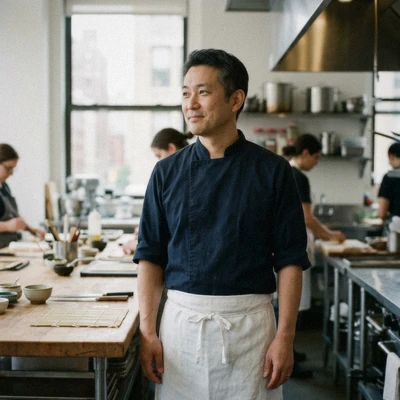
The Brooklyn brewery classes cost $79 for 2 hours, and the Midtown workshop costs $125 for 3, a $46 gap that buys a genuinely different evening rather than just a longer version of the same one. We teach both sides of this comparison, and neither is the wrong pick, they suit different people. Below is the honest sushi making class Brooklyn vs Manhattan breakdown: what changes, what stays the same, and which one fits your evening. If you'd rather see every option first, compare the three classes we compare on the homepage.
Quick answer
Brooklyn works well if you want a casual, social evening with a full meal for $79; Manhattan is worth it if you want an extra hour of nigiri and sashimi technique for $125. For two people, the Midtown workshop runs about $92 more than Brooklyn, a real premium for the added skill depth, not just a longer class.
Key takeaways
- Brooklyn classes cost $79 for 2 hours at Chef Shota's or Chef Davis's session
- Manhattan costs $125 for 3 hours at the Midtown Pro-Chef Workshop
- The $46 gap buys nigiri, sashimi, and temaki technique plus soft drinks with dinner
- Brooklyn's biggest edge is price and free cancellation up to 24 hours before class
- Both feed you a full meal of everything you roll, that part never changes
- Read the full cost breakdown for sample budgets and hidden costs
Brooklyn Brewery Classes vs the Midtown Workshop
Brooklyn Brewery Classes ($79, 2 hours)
- Cheaper by $46 per person with a shorter, more approachable time commitment
- Free cancellation up to 24 hours before class, real flexibility if plans shift
- Casual brewery setting at the Wandering Barman, drinks purchasable at the bar
- Beginner-paced rolling only, no raw fish handling
- Caps at 25 participants, a livelier social group energy
- 10-minute walk from the Montrose Ave L stop
Midtown Pro-Chef Workshop ($125, 3 hours)
- An extra hour of instruction covering nigiri, sashimi, and temaki on top of rolling
- Full sushi dinner plus soft drinks included, nothing extra to buy at the venue
- Deeper coverage of Japanese food culture and history throughout the class
- Smaller cap at 20 participants, a more structured pro-kitchen pace
- Non-refundable once booked, no cancellations or changes accepted
- Short walk from Penn Station, 325 W 37th St
Verdict Brooklyn wins on price, flexibility, and social energy; Manhattan wins on technique depth and what's included in the ticket. Neither one is objectively better, they're built for different evenings.
At a Glance
Every real difference, side by side.
| Brooklyn | Manhattan | |
|---|---|---|
| Price | $79 per person | $125 per person |
| Duration | 2 hours | 3 hours |
| Venue | Wandering Barman, 315 Meserole St, Williamsburg | 325 W 37th St, near Penn Station |
| What you make | California Roll + veggie roll | Rolling plus nigiri, sashimi, and temaki |
| Group size | up to 25 | up to 20 |
| Drinks | purchased at the bar | soft drinks included with dinner |
| Cancellation | free up to 24 hours before | non-refundable |
| Best for | first-timers, casual groups, date nights on a budget | serious learners wanting fuller technique |
What You Get in Brooklyn
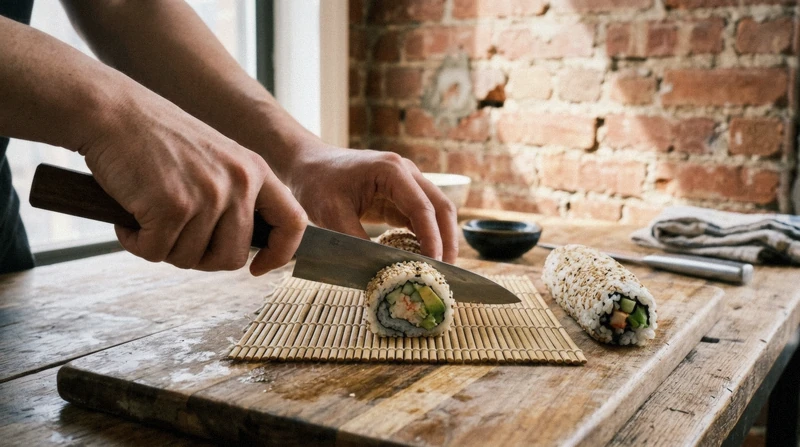
Both Brooklyn classes, whether you book Chef Shota's brewery session or Chef Davis's step-by-step class, run at the Wandering Barman in Williamsburg and teach the same fixed menu: a California Roll (nori, sushi rice, avocado, crab sticks, cucumber) and an American-Style Veggie Roll (nori, sushi rice, mango, avocado, cucumber). Chef Davis's class leans more step by step, walking through seasoning the rice, slicing, then rolling in sequence, while Chef Shota's keeps a slightly more relaxed, social pace. Craft drinks are available for purchase at the bar, not included in the $79 ticket, and free cancellation up to 24 hours before class gives you real flexibility if plans change.
The room itself does a lot of the work here. The Wandering Barman is a working bar with exposed brick and taps behind the counter, so the class runs with the noise level of a night out rather than a classroom. That suits people who came for the evening as much as the technique. If you are the kind of person who wants silence while you concentrate on a knife, that is a genuine mark against Brooklyn rather than a quirk we would talk you out of.
Neither Brooklyn class handles raw fish. Both rolls use crab sticks (surimi) and vegetables, which is why they work so well for guests who like the idea of sushi more than the reality of sashimi. Surimi alternatives are available on request if there is a shellfish issue at your table, and the veggie roll is fully plant-based as written, so a mixed group rarely needs to negotiate anything with the host beyond a note at booking.
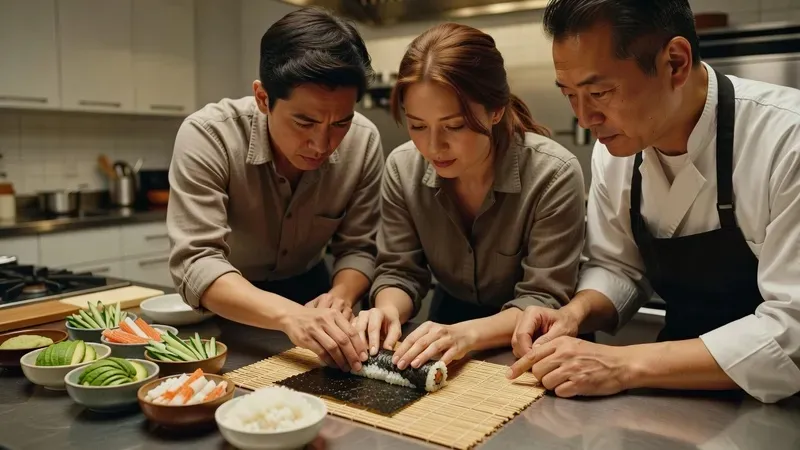
One reassurance worth stating plainly: if you book as a couple or a group, you stay together at your own table for the class. The strangers in the room are the other guests around you, not the people you actually booked with, so nobody splits up your party to fill seats elsewhere.
What Changes in Manhattan
The Midtown pro-chef workshop adds nigiri, sashimi, and temaki (hand rolls) on top of the rolling fundamentals taught in Brooklyn, plus a walkthrough of Japanese food culture and history across the extra hour. A full sushi dinner and soft drinks come included in the $125 price, so there is no bar tab to add at the end of the night.
Nigiri is the reason the extra hour exists. Rolling is forgiving, a loose roll still tastes fine, but hand-pressed rice under a slice of fish is where technique becomes visible on the plate, and it takes a chef standing at your shoulder to correct the pressure. That is also why the room caps at 20 rather than 25. Fewer guests means the chef can actually reach everyone during the part of the class that needs individual correction.
The workshop rated 4.5 from 19 reviews, and reviewers consistently single out the food-history side of the teaching rather than only the cooking. The exact fish used for the nigiri and sashimi portion varies by session depending on what the kitchen has that day, so treat that as a detail to confirm with the host rather than a fixed menu.
What does not change: it is still a beginner-friendly class, no prior experience required, and you still sit down to eat everything you made. Both sides of this comparison end the same way, with a real dinner you rolled yourself.
The Real Price Difference
The $46 gap between $79 and $125 buys three concrete things: an extra hour of class time, nigiri and sashimi technique that Brooklyn doesn't teach at all, and soft drinks included with dinner instead of a separate bar tab. For two people, that's about $92 more total, which roughly covers two rounds of drinks at the Brooklyn bar anyway, so the real out-of-pocket gap narrows once you count what you'd spend on drinks in Brooklyn versus what's already bundled at Midtown.
It's worth it if nigiri and sashimi technique genuinely matter to you, or if you'd rather not think about a bar tab during the class. It's not worth it if you're strictly budget-first or you know raw fish isn't your thing, since Brooklyn's crab-and-vegetable menu covers that case by design.
Worth naming plainly: this isn't a shared-versus-private comparison, so there's no group discount that changes the math as your party grows. A group of four pays $79 times four at Brooklyn or $125 times four at Midtown either way, the per-person price stays fixed regardless of how many people book together. The only thing that shifts with group size is how much the shared bar tab or shared tip gets split, which is where Brooklyn's lower base price compounds into real savings for a bigger group.
What Stays the Same Either Way
Before the differences pull your decision around, it is worth seeing how much of the evening is identical in both boroughs. The core lesson, the meal, and the beginner-level pitch do not change with the price.
| What you might expect to differ | Brooklyn | Manhattan |
|---|---|---|
| Experience required | None, built for beginners | None, built for beginners |
| Who prepares the rice | You do, seasoned from scratch in class | You do, seasoned from scratch in class |
| Tools and ingredients | All provided, bring nothing | All provided, bring nothing |
| The meal at the end | Sit-down meal of everything you rolled | Sit-down meal of everything you rolled |
| Dietary requests | Handled if shared at booking | Handled if shared at booking |
| Do you keep the skill | Yes, the rolling method transfers home | Yes, plus nigiri shaping |
Read that table before the price one. It is the honest answer to the most common version of this question, which is really "am I missing out if I book the cheaper class?" On the fundamentals, no. The $46 buys additional technique on top of a lesson that is already complete, not a fix for something Brooklyn leaves out.
Vibe and Depth
Brooklyn feels like a social night out that happens to include a cooking lesson, exposed brick, a working brewery, a livelier room of up to 25 people. Manhattan feels more like a structured lesson with a professional chef, smaller at 20 people, with more one-on-one correction during the nigiri and sashimi portions. Neither vibe is better, one suits a group of friends out for the evening, the other suits someone who wants to leave with a fuller skill set.
Both are genuinely beginner-paced, so depth here means how much technique you leave with, not how hard the class is. Someone who's never held a sushi knife handles either room fine; the real question is whether you'd rather spend the extra hour on more skill or spend it back at the bar with a drink in hand.
Getting There
The Brooklyn classes are a 10-minute walk from the Montrose Ave L stop, an easy trip from most of north Brooklyn and lower Manhattan. The Midtown workshop sits at 325 W 37th St, a short walk from Penn Station, which makes it the simpler pick if you're coming from New Jersey, Long Island, or anywhere the LIRR or NJ Transit already lands you.
Both venues are wheelchair accessible, and both classes ask that you arrive about 10 minutes early to check in and get settled at your station before the briefing starts. Neither location requires anything unusual to bring, everything you need is already at your seat when you arrive, so travel time is really the only logistics question worth planning around ahead of the day.
Budget the travel time honestly on a weeknight. Getting to Williamsburg from Midtown means the L, which can be slow in the evening, and the Brooklyn classes ask you to check in about 10 minutes before the start. Coming the other way, Penn Station to 325 W 37th St is a walk of a few minutes, which is why the Midtown workshop is the easier pick for anyone arriving into the city on the day of the class rather than starting from home.
Who Should Book Which
If It's a date night on a budget
Book Brooklyn. The social brewery setting and $79 price beat a pricier structured class for a casual evening out.
If You're a serious learner who wants real technique
Book the Midtown workshop. Nigiri and sashimi instruction only happens there, and the extra hour goes toward genuine skill.
If You're bringing a group of friends
Book Brooklyn. The livelier room and lower price per person suit a group evening better than a structured pro-kitchen pace.
If Price matters most
Book Brooklyn. At $79 with free cancellation up to 24 hours, it's the lower-risk, lower-cost option outright.
If You're buying this as a gift
Either works, but Midtown's included dinner and drinks make gifting simpler since there's nothing extra for the recipient to pay at the venue. Our gift guide covers booking either as a present.
What We'd Book
If someone asked us tonight, most couples and first-timers should book Brooklyn. The $79 price, the social brewery setting, and the free 24-hour cancellation make it the lower-risk choice for a fun evening, and the meal at the end is just as real as Midtown's. We'd only point someone toward the $125 Midtown workshop if nigiri and sashimi technique specifically matter to them, or if the non-refundable policy genuinely doesn't worry them because their date is locked in. For the date-night angle specifically, our date night guide goes deeper on which venue fits that occasion best.
We say this knowing we teach both classes ourselves, there's no incentive on our end to push one over the other, both are booked through the same page. The honest answer really is that most people are happy with the cheaper option, and the extra $46 only earns its keep for a specific kind of traveler: someone who wants to walk out knowing how to make nigiri, not just a roll.
Frequently Asked Questions
When is the Manhattan sushi workshop worth the extra cost?
It's worth it if nigiri and sashimi technique matter to you, or if you'd rather have soft drinks included than pay for a bar tab. If you just want a fun, cheaper evening with a full meal, Brooklyn covers that at $46 less per person.
How long is each sushi class?
The Brooklyn classes run 2 hours; the Midtown workshop runs 3 hours, with the extra hour going toward nigiri, sashimi, and temaki instruction.
What do you actually make in each class?
Brooklyn: a California Roll and a veggie roll. Manhattan: the same rolling fundamentals plus nigiri, sashimi, and temaki (hand rolls).
Why is the Manhattan class non-refundable while Brooklyn isn't?
It's a policy set by each operator rather than the venue type. Brooklyn classes offer free cancellation up to 24 hours before class; the Midtown workshop accepts no cancellations or changes once booked, so confirm your date before paying.
Which class is better for a group of friends?
Brooklyn, generally. It caps at 25 participants versus Midtown's 20, and the brewery setting suits a livelier group evening better than the more structured pro-kitchen pace.
What meal is included at each location?
Yes. Every class, Brooklyn or Manhattan, ends with a sit-down meal of everything you rolled. Manhattan also includes soft drinks with that meal; Brooklyn does not.
How far is each venue from the subway?
The Brooklyn classes are a 10-minute walk from the Montrose Ave L stop. The Midtown workshop is a short walk from Penn Station.